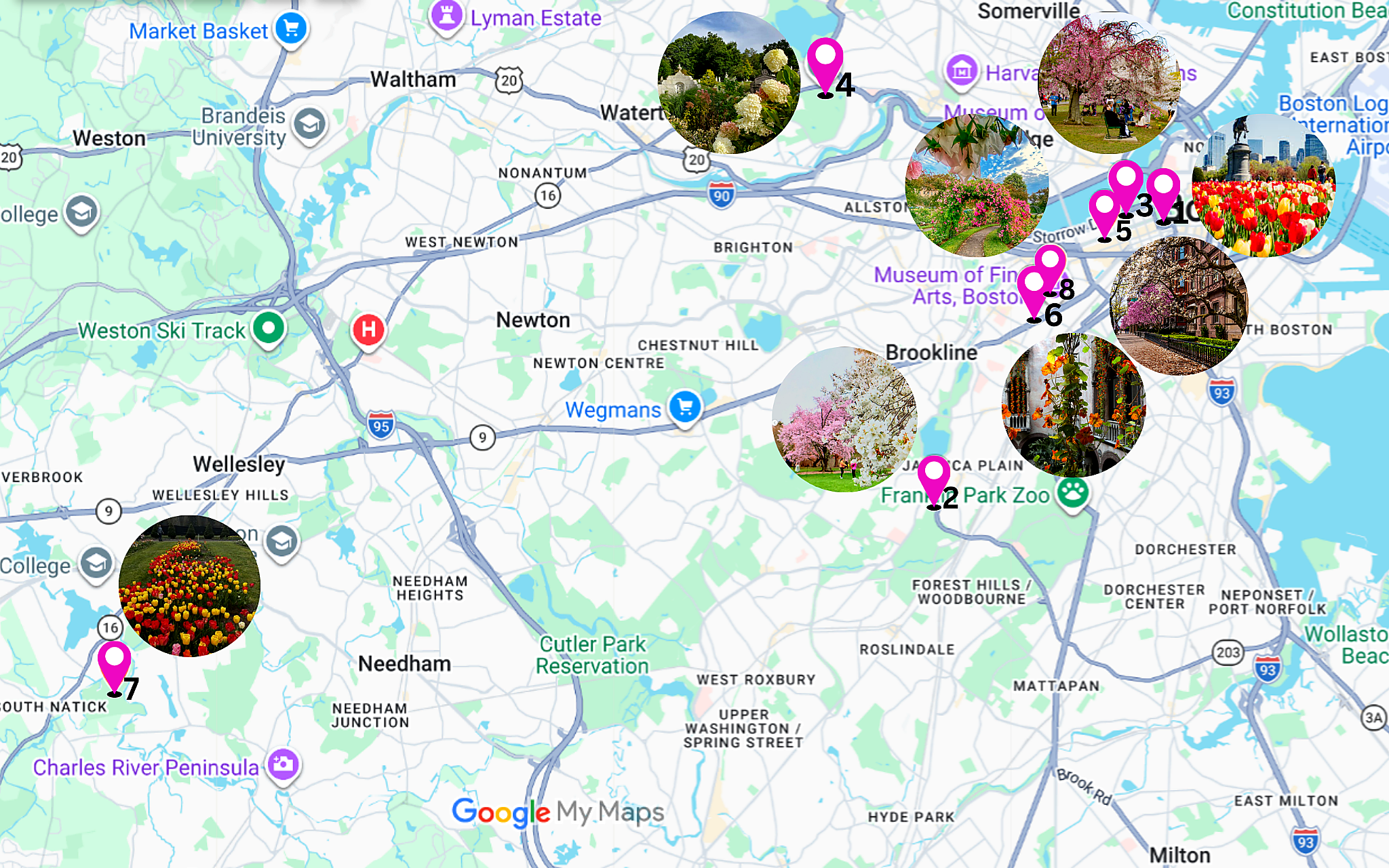
Topics covered:
Boston Public Garden
Arnold Arboretum
Charles River Esplanade
Mount Auburn Cemetery
Commonwealth Avenue Mall
Isabella Stewart Gardner Museum
MA Horticultural Society Garden
James P Kelleher Rose Garden
After a long and brutal winter, there is nothing quite like the first pop of color in the city. Boston transforms into a living watercolor painting from late March through June, with gardens, parks, and historic landscapes bursting into bloom.
If you're looking to catch the spring blooms at their peak, hitting these 8 must-visit locations will take you from 100-year-old museum traditions to world-class arboretums, showcasing the very best of the season.
Often called the "holy grail" of spring flower spotting in the city, the Boston Public Garden is a 24-acre horticultural showcase. Designed in a Victorian style, it features formal floral patterns, winding paths, and some of the most iconic blooming trees. It is also the nation's oldest public botanical garden.
From late April through mid-May, the garden erupts with color. Visitors can see daffodils, twelve varieties of magnolias, Yoshino cherry blossoms, Kwanzan cherry blossoms, tulips, lilacs, rhododendrons, and crabapple trees in bloom. At the same time, the weeping willows surrounding the lagoon turn a bright chartreuse, adding a luminous green glow to the landscape.
Best time to visit: Early morning offers softer light and fewer crowds.
Highlight Flower(s): Tulips - more than 31,000 bulbs planted each year, creating bold waves of color throughout the park.
Cost: Free and open to the public
Recommendations:
Ride the Swan Boats. They usually return to the water just as the tulips reach their peak, making the experience feel even more magical.
The Arnold Arboretum is most famous for Lilac Hill, home to one of the largest lilac collections in North America. The bloom reaches its crescendo during Lilac Sunday, held every Mother’s Day. It is a singular Boston tradition and the only day of the year when visitors are allowed to picnic on the grass, drawing thousands who come to celebrate the fragrance and beauty of the lilacs at their peak.
Managed by Harvard University, this 281-acre living museum of trees is one of the largest and most diverse green spaces in Boston. Because of its vast landscape, the bloom season here often feels longer than elsewhere in the city. While one section of the arboretum may just be waking up, another may already be at peak color.
Beyond lilacs, early spring begins with the subtle blooms of red maples and witch-hazels, followed by the deep pink blossoms of Prunus sargentii (Sargent’s cherry). As May progresses, the grounds burst into color with magnolias, forsythias, tree peonies, rhododendrons, and azaleas lining the winding paths.
Best time to visit: Weekends during peak bloom (especially Lilac Sunday) are extremely busy; weekdays are recommended for a quieter experience.
Highlight Flower(s): Lilacs on Lilac Hill
Cost: Free and open to the public
Recommendations:
Attend "Lilac Sunday" and enjoy a picnic
Check the bloom map on their website before visiting to time your trip.
Try the "Early Spring Blooms" guided tour
Visit during golden hour for the best blossom photography.
Running for three miles along the Charles River, the Esplanade is arguably one of the most Instagrammable places in Boston during spring. While the park is a year-round favorite for runners, cyclists, and sailors, it transforms into an enchanting floral corridor in mid to late April when the cherry trees begin to bloom.
Near the Hatch Memorial Shell and the Fiedler Footbridge, Yoshino cherry trees form a canopy of delicate pink and white blossoms. When the wind picks up, petals drift down onto the paths like pink snow, creating a magical scene against the shimmering Charles River.
Best time to visit: Sunrise or golden hour near sunset when the light reflects off the river.
Highlight Flower(s): Yoshino and Kwanzan Cherry Blossoms.
Cost: Free and open to the public
Recommendations:
Rent a Bluebikes and cycle the path from the Museum of Science toward Back Bay to see the full density of the blooms
Bring a blanket and enjoy a picnic on the lawn, watching the sunset over the river.
It may seem unconventional to visit a cemetery for flowers, but Mount Auburn was America’s first “rural cemetery”, designed as a landscape for reflection, nature, and remembrance. Today, this 175-acre National Historic Landmark is a world-class arboretum and one of the most peaceful places in Greater Boston to experience the changing seasons.
The bloom season begins as soon as the snow melts, when hellebores, winter aconite, and snowdrops push through the frost. By April, the rolling hills become a patchwork of color as carpets of daffodils and scilla bloom beneath canopies of magnolias and ornamental cherry trees.
By May, the landscape reaches its peak with dogwoods, azaleas, and lilacs washing the hillsides in vibrant color.
Best time to visit: Early morning. The main entrance at 580 Mount Auburn Street opens early at 6:00 AM to accommodate "quiet hours" for birdwatchers and early risers before maintenance vehicles begin operating at 8:00 AM.
Highlight Flower(s): Scilla and Daffodils - these create incredible "blue and gold" carpets across the grassy hills.
Cost: Free and open to the public (please remember to follow cemetery etiquette).
Recommendations:
Climb Washington Tower for a panoramic view of the blooming cemetery set against the Boston skyline.
Bring binoculars. This is a premier "migratory trap" where birdwatchers flock to see colorful warblers in the flowering branches.
Not a mall, but a park. This grand 32-acre linear park runs through the heart of Back Bay, framed with historic brownstones and a majestic canopy of trees that lend a quiet elegance to the city streets. Walking down "Comm Ave" in Boston’s Back Bay can feel like stepping into a Parisian postcard.
The true stars of the show here are the magnolias. In mid-April, massive saucer and star magnolias erupt in shades ranging from pearly white to deep fuchsia. Their giant, waxy blooms frame the surrounding Victorian architecture, creating one of the most iconic spring scenes in Boston - the moment when the city finally feels like it has shaken off winter.
Best time to visit: Late morning or early evening for the best lighting along the tree-lined path.
Highlight Flower(s): Magnolias
Cost: Free and open to the public
Recommendations:
Start your walk near the Public Garden and continue west towards Kenmore Square
While most of Boston’s blooms are found under the open sky, the Isabella Stewart Gardner Museum offers a legendary indoor tradition. The Venetian-style covered courtyard is a year-round masterpiece, but it reaches iconic status in April during the hanging nasturtium display. These dramatic, fiery orange, twenty-foot vines drape from the third-floor balconies down toward the ancient sculptures below - a tradition started by Isabella herself to celebrate her April 14th birthday.
The nasturtiums are the stars, but they are part of a lush, multi-layered floral symphony. At their feet, you’ll find a sea of vibrant Cineraria in deep blues and purples, creating a striking color contrast, alongside frothy Azaleas and elegant Calla Lilies. As spring progresses into May, the display transitions into a romantic "cotton candy" palette of towering Delphiniums, Foxgloves, and mophead Hydrangeas. Even the outdoor Monk’s Garden joins the show, with delicate Hellebores and Bleeding Hearts lining the serpentine stone paths.
Best time to visit: Late March through mid-April for the nasturtiums; May for the hydrangeas.
Highlight Flower(s): Hanging nasturtiums.
Cost: $22 for adults, with discounts available for seniors and students. Children under 17 are free with a ticket. Reservations are highly recommended.
Recommendations:
Watch This Is a Robbery: The World's Biggest Art Heist on Netflix before your visit for a sense of the drama that unfolded during the infamous 1990 art heist- those 13 art pieces that were stolen are still missing!
Book a themed guided tour.
The horticultural team hides rare Orchids in the stone niches of the walls - see if you can spot them!
Located just a short drive from the city in Wellesley, Elm Bank is a 36-acre horticultural treasure. Managed by the oldest horticultural society in the US, this estate feels like a secret garden. It offers a more structured, educational look at spring, featuring several distinct "rooms," including a whimsical Children’s Garden and the classic Italianate Garden.
Spring here is defined by "Tulip Mania," where thousands of bulbs are planted in vibrant, sweeping displays across the estate. Unlike the city’s smaller parks, Elm Bank offers wide-open spaces and a sense of horticultural "perfection" that makes it worth the trip for anyone looking to see rare varieties and expertly manicured borders.
As the tulips fade away in late May, the Italianate Garden and the Bressingham Garden take center stage. The latter, designed by Adrian Bloom, features "rivers" of perennials and shrubs that create a sense of movement through the landscape. From the massive Rhododendrons to the delicate Peonies, the variety here is unparalleled in the Greater Boston area.
Best time to visit: Late May through early June for the full perennial explosion.
Highlight Flower(s): Rare Tulip variety and Peonies
Cost: General admission starts at $5 for youth aged 3 to 27, and $14 for adults. MHS members are free.
Recommendations:
Check MassHort for all garden updates.
Pack a picnic; the expansive lawns are perfect for a family afternoon outside of the urban hustle.
Tucked away behind tall hedges in the Back Bay Fens, the James P. Kelleher Rose Garden is the grand finale of the Boston spring season. Often described as a "hidden gem," this formal, sunken garden serves as a masterclass in classical landscape design. While the rest of the city peaks in April and May, this sanctuary waits until early to mid-June to reveal its glory, featuring nearly 1,500 individual plants across 200 different varieties.
Walking through the ornate iron gates, you are greeted by the intoxicating scent of heirloom roses arranged around a central fountain and geometric stone-dust paths. The true spectacle occurs when the climbing roses on the wooden trellises reach their peak, creating a fragrant, romantic tunnel of color. It is one of the most peaceful corners of the city, offering a living canopy that feels miles away from the nearby bustle of Fenway Park.
Best time to visit: Mid-June for the "First Bloom."
Highlight Flower(s): Heirloom Roses, Floribundas, and Climbing Roses.
Cost: Free and open to the public.
Recommendations:
Access it from Park Drive; it is shielded by high hedges, making it feel like a true discovery.
Look for the "Tuesdays with Roses" volunteer program if you want to learn how to prune and care for these iconic blooms alongside the experts.